ICE Cotton Futures: Bulls and Bears Contest for Directional Control
Weekly Report · 15 July 2026 · Hedge$Pro
Executive Summary:
Rainflo retains its forecast of 76.11 – 80.47 cents per pound for December 2026 ICE Cotton futures, first established on 24 June, and reaffirmed on 9 July. Elevated volatility has, however, increased the probability of temporary price extensions to 80.50 – 82.50 cents per pound on the upside and 75.50 to 76.11 cents per pound on the downside.
The U.S. remains the principal source of upside risk as deteriorating crop conditions in Texas continue to support the bullish case. India has shifted from a bullish uncertainty to a broadly neutral factor following improved sowing progress, while China’s weather-related risks continue to be moderated by the upcoming commencement of sales from strategic reserve and ample import cotton inventories in the port warehouses. We also assign a lower weight to the U.S. Dollar as a headwind following the revision in our DXY outlook, while continuing to view elevated crude oil prices as a net negative for cotton demand through their impact on textile margins.
1. Recap of Earlier Advisories:
In our market note dated 24 June, we projected that December 2026 ICE Cotton futures would remain range-bound between 76.11 cents per pound and 80.47 cents per pound in the near term. This forecast held for 12 days, until 7 July, when a technical breakout pushed cotton futures above the upper boundary, with the contract settling at 81.29 cents per pound.
In our subsequent market note dated 9 July https://www.hedgespro.com/cotton/2026-07-09-cotton1.html ,we identified ‘volatility target driven – capital rotation’ from other commodity futures into cotton futures - as the primary factor behind the sharp increase in open interest observed on 7 July.
We also re-assessed the key bullish and bearish factors influencing cotton prices and concluded that available evidence did not indicate that either side had gained a decisive advantage. Accordingly, we retained our near-term trading range of 76.11 – 80.47 cents per pound, while acknowledging an upward bias, in the 9 July market note.
2. Key Supply-Side Observations From 9 July Report:
United States: Deteriorating crop conditions in Texas indicated emerging supply side-risk
China: Xinjiang heat stress posed a production risk, with several policy related variables contributing to uncertainty
India: Delayed monsoon progression and uncertainty around final cotton acreage represented a potential bullish risk
In today’s note, we revisit these bullish and bearish factors, following the escalation of hostilities between the United States and Iran beginning 11 July. We assess whether the latest geo-political developments, alongside evolving weather risks in the United States and Xinjiang have materially altered the balance of evidence for December 2026 ICE Cotton futures.
2.1. United States: Continuing Weather Risks
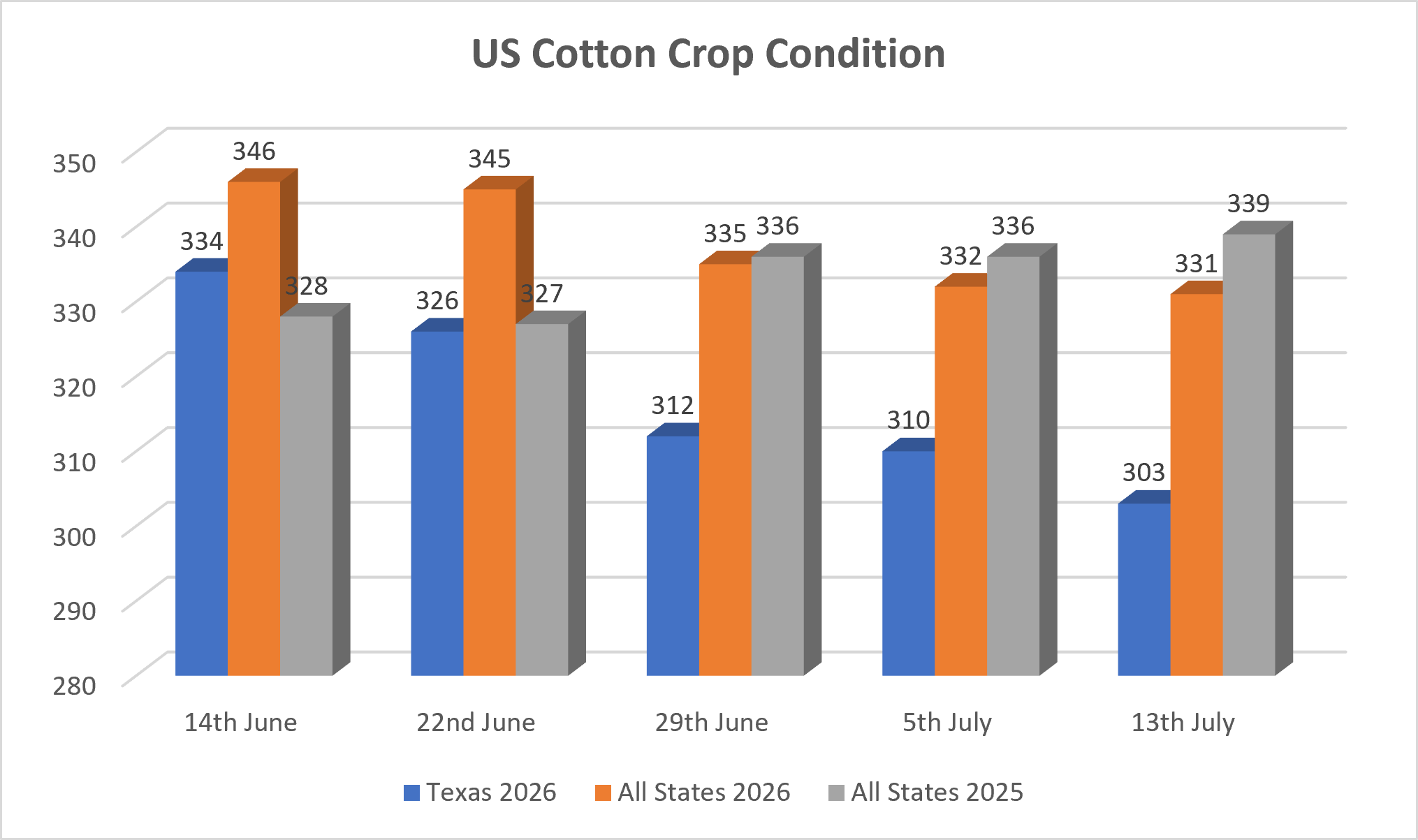
U.S. crop conditions continued to deteriorate between 5 July (the reporting date considered in our 9 July note) and 13 July. The Texas crop condition index declined to 303, approaching the threshold level of 300, which historically has been associated with periods of significant crop stress. The deterioration increases the probability of downward yield revisions should adverse weather persist during the crop’s critical development phase.
Temperature and Precipitation Forecasts from United States:
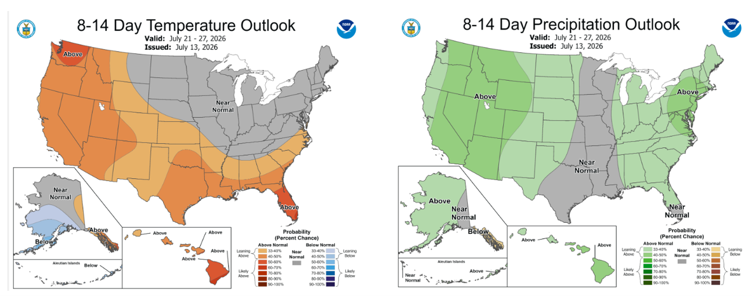
The latest 8-14 day outlook, issued on 13 July, indicates a less favourable precipitation outlook for Texas than the outlook released on 8 July. While the extreme western heat signal has moderated and temperatures across central and eastern United States have shifted closer to normal, the precipitation outlook has deteriorated, with much of Texas now expected to receive only near-normal rainfall, rather than the above-normal precipitation indicated a week earlier. These developments provide important context for interpreting the USDA’s July WASDE production forecast.
U.S. Cotton Supply and Use – July WASDE, USDA:
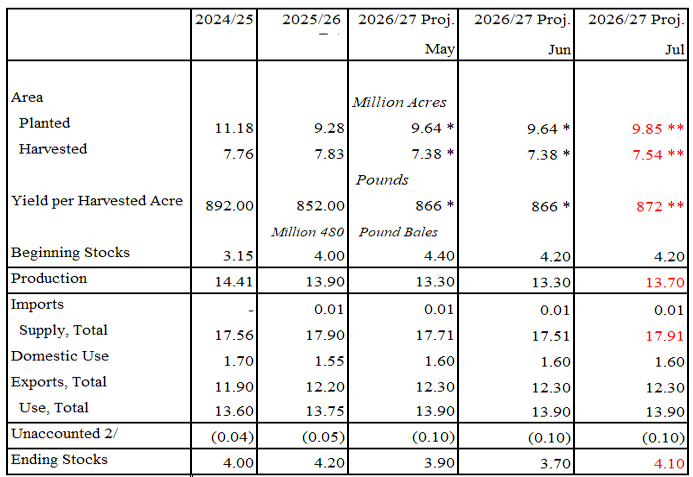
One of the notable features of the July WASDE report was USDA’s production forecast of 13.70 million bales, which was below prevailing market expectations. Prior to the release of the report, several respected analysts had projected the U.S. crop to exceed 14.0 million bales, with some estimates reaching 14.25 million bales. The divergence between USDA’s forecast and private analysts’ forecasts likely reflected differing assessments of crop potential amid rapidly evolving weather situation in Texas during early July.
Subsequent developments have shifted the balance of evidence.
Since the release of the July WASDE report, U.S. crop condition ratings have continued to deteriorate, while the latest precipitation outlook for Texas has become less favourable than it was a week earlier. Should these weather risks persist, market expectations centred on a U.S. crop exceeding 14.0 million bales may require downward revision, bringing private estimates closer to the USDA’s forecast of 13.70 million bales.
2.2. China: Xinjiang Weather Risk Partially Offset by Supply Availability
In our 9 July note, we highlighted Xinjiang heat stress as a potential source of uncertainty for China’s cotton production as the crop entered the flowering and boll formation stages.
Heat concerns have persisted, particularly in Southern Xinjiang. However, the production impact remains difficult to quantify due to the region’s adaptive capacity. Extensive irrigation infrastructure and adoption of drip irrigation systems could help mitigate the impact of elevated temperatures. Chinese breeding programs have developed cotton varieties with improved tolerance to high temperature stress, reducing, although not eliminating, the risk of significant yield losses.
Therefore, at this stage, it is not possible to determine whether the ongoing heat stress will result in a meaningful deviation from USDA’s production forecast of 33.50 million bales for China.
Figures in Million 480-pound bales:
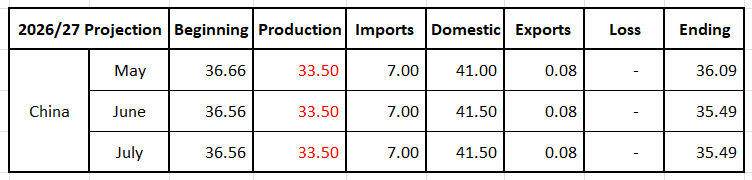
In our previous report, we identified three key uncertainties regarding China’s cotton market:
Timing and volume of potential releases from China’s strategic cotton reserves
Allocation and availability of import quotas
The possibility of cotton featuring prominently in upcoming US-China trade discussions
Sales from China’s Strategic Reserve:
Cotlook has since reported that the China National Cotton Reserves Company will commence strategic reserve sales from 20 July 2026. The auction base price will be adjusted weekly and calculated using a 50/50 weighting of domestic spot prices and the Cotlook A Index. This removes the uncertainty surrounding the timing of potential releases from China’s strategic cotton reserves.
Import Cotton Inventories in Chinese Ports:
Imported cotton stocks at major Chinese ports remain above 575,000 tons, with approximately 85% concentrated at Qingdao port. This suggests that mills currently have sufficient access to imported cotton and are unlikely to accelerate purchases solely in response to weather concerns.
Seasonality of Chinese Demand:
Furthermore, textile demand remains seasonally weak during July and the first half of August. Mills are therefore expected to maintain procurement focussed on immediate requirements rather than inventory accumulation.
United States – China Trade Negotiations:
Regarding potential U.S. China cotton trade discussions, market speculation remains elevated that cotton could form part of a broader agricultural purchasing agreement. However, available evidence remains less conclusive than in the Soyabeans market.
Historical trade patterns suggest that U.S. agricultural agreements with China have typically been concentrated in major commodities such as soyabeans, while non soyabean commitments have been comparatively smaller.
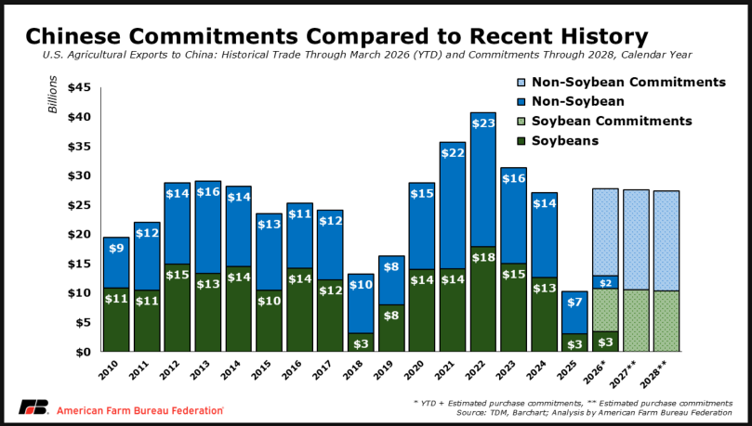
Therefore, although a cotton related trade agreement would present a potential upside catalyst for ICE futures, the magnitude and timing of any such demand remain uncertain.
Conclusion:
While Xinjiang weather remains a supportive factor, available inventories, strategic reserve sales, and weak seasonal demand limit the immediate bullish implications for global cotton balance sheet.
2.3. India: Acreage Risk Has Moderated
In our 9 July note, we identified India as a potential supply side risk due to uncertainty regarding final cotton acreage. Improved monsoon rainfall and the progress in sowing over the past few days has materially reduced this uncertainty.
Cotton sowing in India has exceeded 7.0 million hectares, with the deficit compared with last year narrowing to less than 10%. Current trends suggest India has a reasonable possibility of achieving, and potentially exceeding, last year’s planted acreage of approximately 11.3 million hectares.
Therefore, the earlier concern of a significant acreage driven reduction in Indian cotton production has largely dissipated. However, delayed sowing remains a factor to monitor, as a compressed crop development window could still affect yield potential and fibre quality during the later stages of the crop cycle.
As highlighted in the previous report, the evolution of the Indian Ocean Dipole (IOD) and its interaction with El Nino conditions remain important variables to monitor.
Overall, India has shifted from being a major bullish uncertainty to a neutral factor.
India is unlikely to provide a significant tightening impulse to the global cotton balance sheet unless subsequent weather developments adversely affect yields or fibre quality.
2.4. Overall Supply Side Assessment:
The U.S. remains the principal source of supply side uncertainty, with deteriorating crop conditions and adverse weather risks potentially supporting a tighter balance sheet.
In contrast, China’s weather concerns are partially offset by available inventories, strategic reserve sales, and subdued near term demand. The impact of ongoing heat stress is difficult to quantify at this stage.
India’s acreage recovery has further reduced concerns regarding a significant supply disruption.
3. Capital Flow and Options Positioning in December’26 Cotton Futures:
The last significant infusion of fresh capital into December futures occurred on 7 July, when open interest in the December contract increased by 2,864 contracts, while total open interest across all ICE cotton futures contracts rose by 7,391 contracts. As highlighted in our 9 July note, this increase in positioning appeared to reflect ‘volatility targeting – capital rotation’ from other commodity futures, particularly coffee and cocoa.
The open interest declined alongside falling prices on 8 and 9 July, suggesting that profit-taking by longs contributed to the retreat from the 7 July high of 81.29 cents per pound.
An important, though less visible feature of the subsequent price recovery was the adjustment in options market positioning. Between 9 and 13 July - the buyback of 1,682 short call contracts at the 80 cents strike in December futures – helped lift prices back above the 81.00 cents per pound threshold. This move reflects a recalibration of options positioning rather than an infusion of fresh bullish capital.
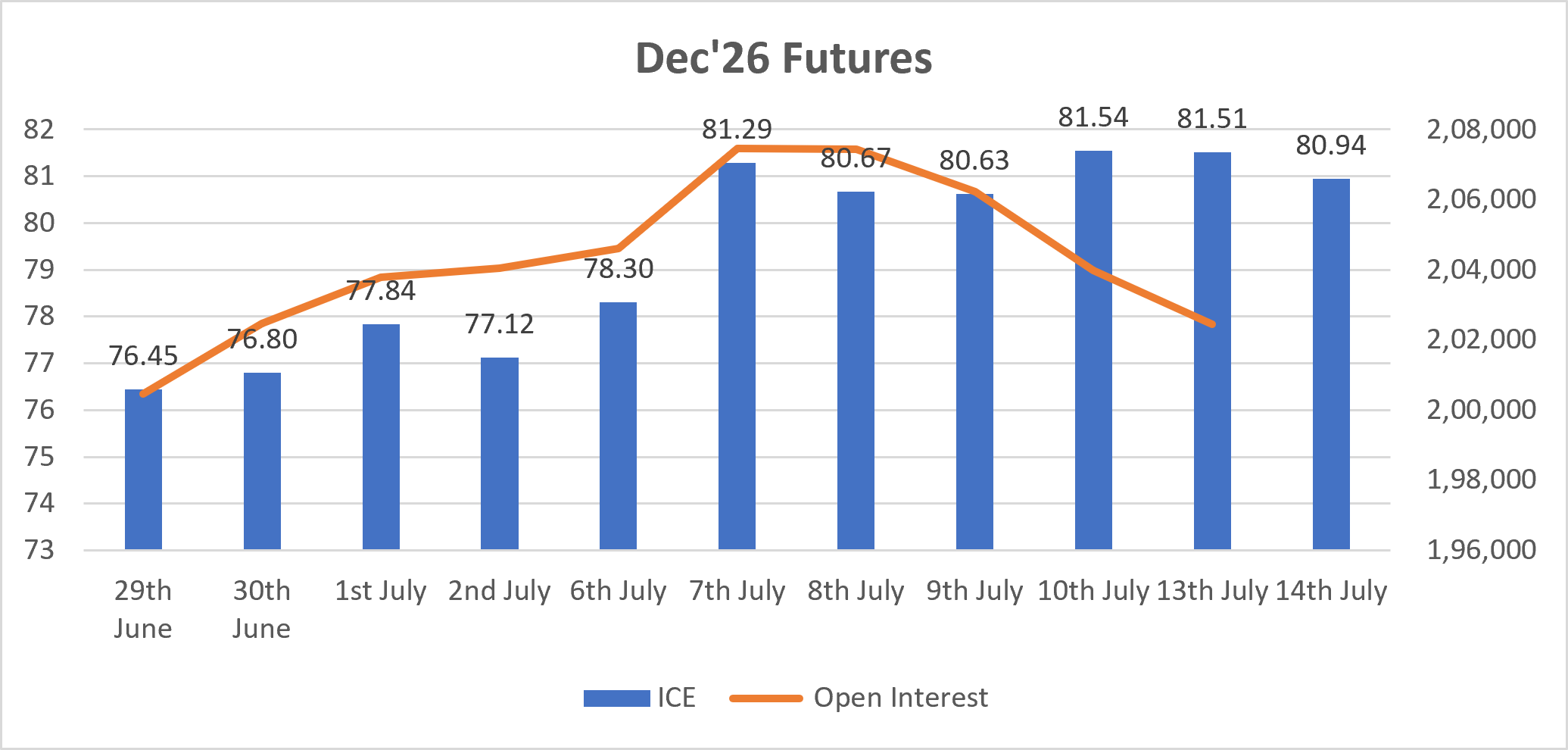
To summarize, subsequent market behaviour has evolved broadly in line with the analytical framework presented in our market notes of 24 June and 9 July. To date, observed price action supports the view that, despite intermittent bursts of speculative activity, neither the bullish nor the bearish factors have established decisive control over the market. Consequently, the balance of evidence remains consistent with the assessment outlined in our 9 July report:
“We continue to expect December cotton futures to remain range bound between 76.11 and 80.47 cents per pound in the near future, albeit with an upward bias, until either the tailwind or headwind factors decisively overwhelm the other”.
4. The U.S. Dollar (DXY) Headwind:
In our 1 July HedgesPro update https://www.hedgespro.com/USD/2026-07-01-DYX.html , we had identified a near term DXY resistance level of 101.82 and support level of 100.85. These reference levels remained valid between 1 July and 14 July.
With subsequent changes in macro variables, the near-term support level is being revised lower to 100.50, while the resistance level remains unchanged at 101.82. A detailed assessment of the factors influencing this adjustment, along with our broader outlook for the DXY, will be presented separately in an upcoming HedgesPro report.
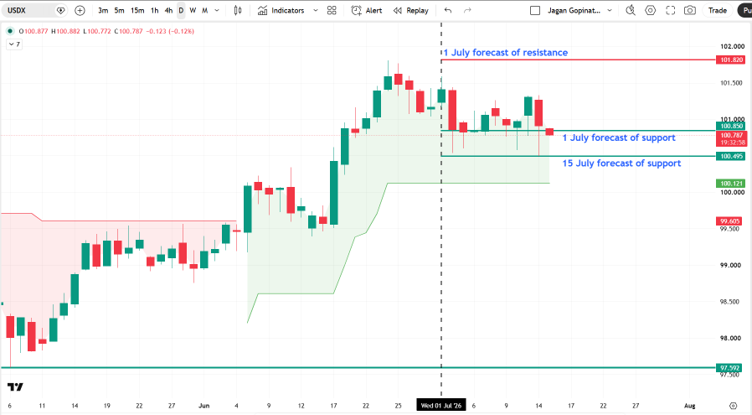
Consequently, while the U.S. Dollar remains a potential headwind for ICE Cotton futures, its adverse impact has moderated relative to our assessment on 9 July.
5. Brent Crude Oil and its Impact on Cotton Pricing:
In our 23 June HedgesPro report on Brent crude oil https://www.hedgespro.com/oil/2026-06-23-brent-crude-oil-what-next-after-us-iran-mou.html , we had identified a support level of $72.95 per barrel, with a very strong support zone between $71 – $69 per barrel.
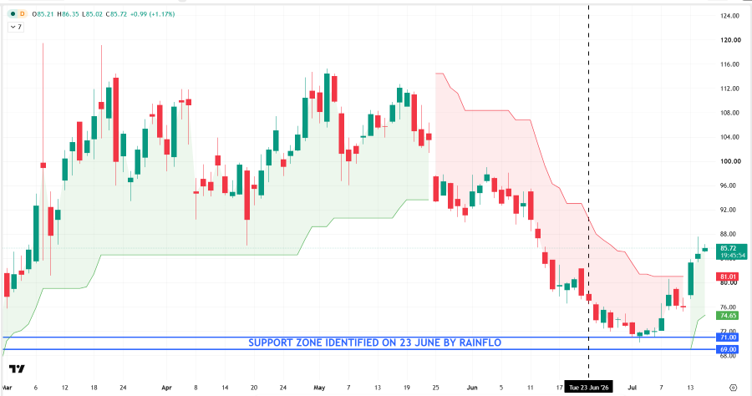
Subsequently, Brent crude declined to a low of $71.80 per barrel on 2 July before rising to $84.73 per barrel on 14 July, representing a move of nearly $13 per barrel over 9 trading sessions.
This surge was driven primarily by short covering in the oil market, a risk highlighted in our 23 June report. We had noted: “Large short positions become vulnerable to a short squeeze when the primary thesis driving the market lower comes under scrutiny due to unpredictable behaviour of key actors”.
The fundamental catalysts behind the short covering were the resumption of hostilities between the United States and Iran as well as the ongoing Ukraine drone attacks on Russian energy infrastructure.
There are two contrasting interpretations regarding the implications of higher crude oil prices for cotton.
Elevated crude oil prices will increase the cost of man-made fibres, thereby improving cotton’s relative competitiveness as a substitute fibre.
The alternative view is that higher Brent crude prices could increase operating costs for textile mills through higher energy and transportation expenses, thereby pressurising global textile margins and weighing on global cotton consumption.
Rainflo’s assessment aligns with the second view.
Unlike the market environment in early February, when cotton prices tracked the sharp increase in crude oil prices, the current environment is unlikely to support a similar transmission mechanism from crude oil to cotton. A detailed assessment of the factors supporting this view will be presented separately in an upcoming HedgesPro report.
6. Weighing the Tailwinds against the Headwinds:
The deterioration in US crop conditions, particularly in Texas, assumes greater importance among the bullish factors in our framework, as only U.S. origin cotton is deliverable against ICE Cotton futures.
We continue to retain the relative weight assigned to China related bullish factors in our model, while acknowledging the moderating impact of the following two variables:
o Timing of the release of cotton from China’s strategic reserves.
o Availability of adequate import cotton stocks at major Chinese ports.
With cotton sowing in India exceeding 7.0 million hectares, and the deficit compared with last year narrowing to less than 10%, India has shifted from being a major bullish uncertainty to a neutral factor in our modelling framework.
We acknowledge that the U.S. Dollar remains a potential headwind for ICE Cotton futures; but we are reducing the weight assigned to this headwind factor following the revision of the near-term DXY support level from 100.85 to 100.50.
We continue to view elevated crude oil prices as a potential drag on textile margins and, consequently, on global cotton demand. This assessment will be retained in our framework with dynamic weighting, until evidence emerges of fresh long-side capital inflows into Brent crude futures.
7. What Next for December Cotton Futures?
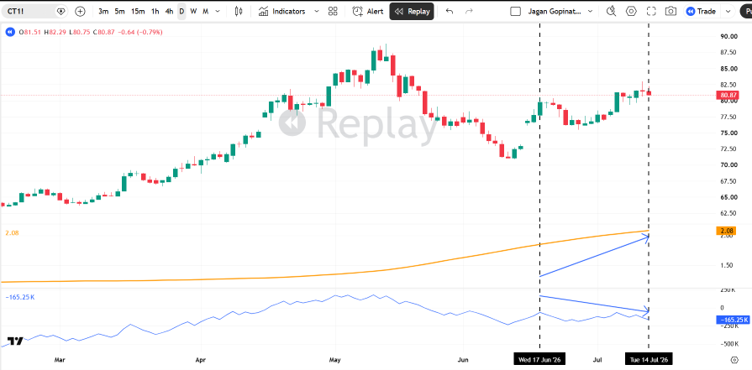
In Rainflo’s forecasting model, the heightened volatility observed in December cotton futures (as reflected by the sharp upslope in the amber coloured volatility tracker) as well as evidence of distribution, rather than accumulation, near recent highs, was weighted against the deterioration in crop conditions in Texas and multiple scenarios of crop damage in Xinjiang, China.
The recalibrated model output suggests that while the underlying price framework identified in our 24 June report and reaffirmed in our 9 July update remains valid, the probability of wider price excursions has increased due to elevated volatility and the growing divergence between bullish supply-side risks and countervailing market factors.
We therefore retain our base-case price forecast range of 76.11 – 80.47 cents per pound.
However, given the current volatility regime, December cotton futures may well temporarily extend towards the 80.50 – 82.50 cents per pound zone on the upside, while the lower boundary is likely to be tested in the 76.11 – 75.50 cents per pound region.
How Rainflo can add Value to your Sourcing, Selling, & Risk Management Efforts?
Participants across the cotton value chain – whether they are producers or consumers of cotton – regularly encounter critical decision-making challenges:
Should cotton be bought or sold now, or should the decision be deferred?
Which risk is currently greater - flat price risk or basis risk?
Should contracts be concluded on a flat price basis or on-call basis?
For existing on-call contracts, is this the appropriate time to fix prices, or is it prudent to wait?
Should the price risk be managed through forward physical market contracts, futures markets, options strategies, or a combination of these approaches?
Rainflo Consulting LLP supports market participants through three complementary service streams:
Rainflo Analytics provides independent market intelligence and analytical frameworks to help participants develop informed market views.
Rainflo Advisory develops customised sourcing and hedging strategies for clients, aligned with their individual risk profile and strategic objectives.
Rainflo Academy delivers structured training programs designed to strengthen market analysis and commodity and foreign exchange risk management capabilities.
If your organisation is seeking support in developing market views, improving sourcing decisions, or managing cotton price risk, we would be pleased to discuss how Rainflo can assist.
Copyright
© 2026 Jagan Gopinath. All rights reserved. No part of this publication may be reproduced, distributed, or transmitted without prior written permission.
Disclaimer
This report is provided for informational and educational purposes only and does not constitute investment, trading, or financial advice. Readers are solely responsible for their decisions. Rainflo Consulting LLP, the platform provider Statoberry LLP and the author accept no liability for any loss arising from the use of this report.